How To Build Your Own Synthetic Covered Call Fund

Welcome to the Schmoozeletter Blog. Your source for weekly water cooler wisecracks from the world of finance. If you have an opinion different than mine or a topic you want to hear about, let me know!
This week, we’re talking about:
How To Build Your Own Synthetic Covered Call Fund

Investing can be really simple:
Buy a low-cost market index fund every two weeks when your paycheck hits.
Boom. Done. Follow this one sentence and you’ll be set for life in thirty years.
Boring!

Investing can also be extremely complicated and high risk using active management and leveraged instruments:
Buy deep-in-the-money call options expiring years from now with a delta close to one so a one-dollar move of the underlying will cause a roughly one-dollar move in the option price, and then sell shorter-term calls against those positions for current income.
Fun!
Is there a chance of you losing everything and completely blowing up your account, causing you to spiral into a depression where you push away your loved ones and stop bathing until you are a lonely, broke, smelly old fool eating cat food out of people’s garbage for dinner?

Yes.
This is:
How To Build Your Own Synthetic Covered Call Fund
Step 1: Stock Selection
This is the only step that matters.
Look at me. Look at me. Look at me.

The entire thing depends on the stock going up.
If you try to do this with a stock that will not rise in price over the holding period, you will lose money.
If the market has a prolonged downtrend, like from a recession, and multiples compress, causing the stock price to go down, you will lose money.
If the stock is under the strike price at expiration, the option will be worthless, and you will lose everything.
Fun!
For our example fund, we are going with a lineup of:
AMZN, MA, META, MSFT, & NVDA.
Step 2: Buy LEAPS
Put money that you will almost definitely lose in Robinhood.
Buy the longest-dated call option you can where the “Delta” is around .90.
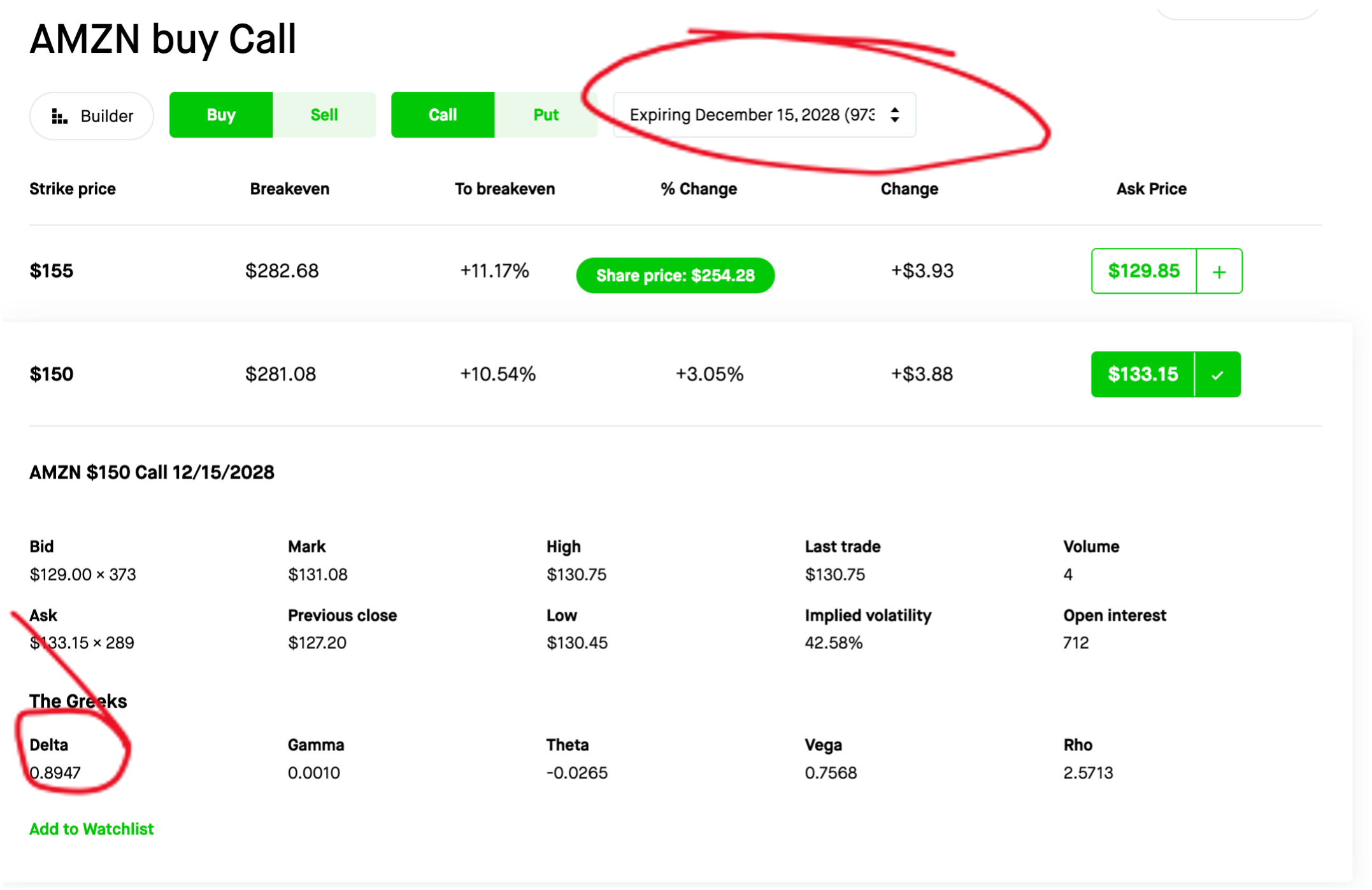
After pushing the buttons and shelling out $13,315, you now own 1 contract that gives you the right, but not the obligation, to purchase 100 shares of AMZN on 12/15/28 for $150 per share.
Oh, you thought running your own synthetic covered call fund would be cheap?
Step 3: Sell Calls
You’ve got a call option to work with, so use it to generate income.
Pick a call with an expiration date one month from now.
Pick a strike price ABOVE the price of the stock when you bought your call in Step 2.
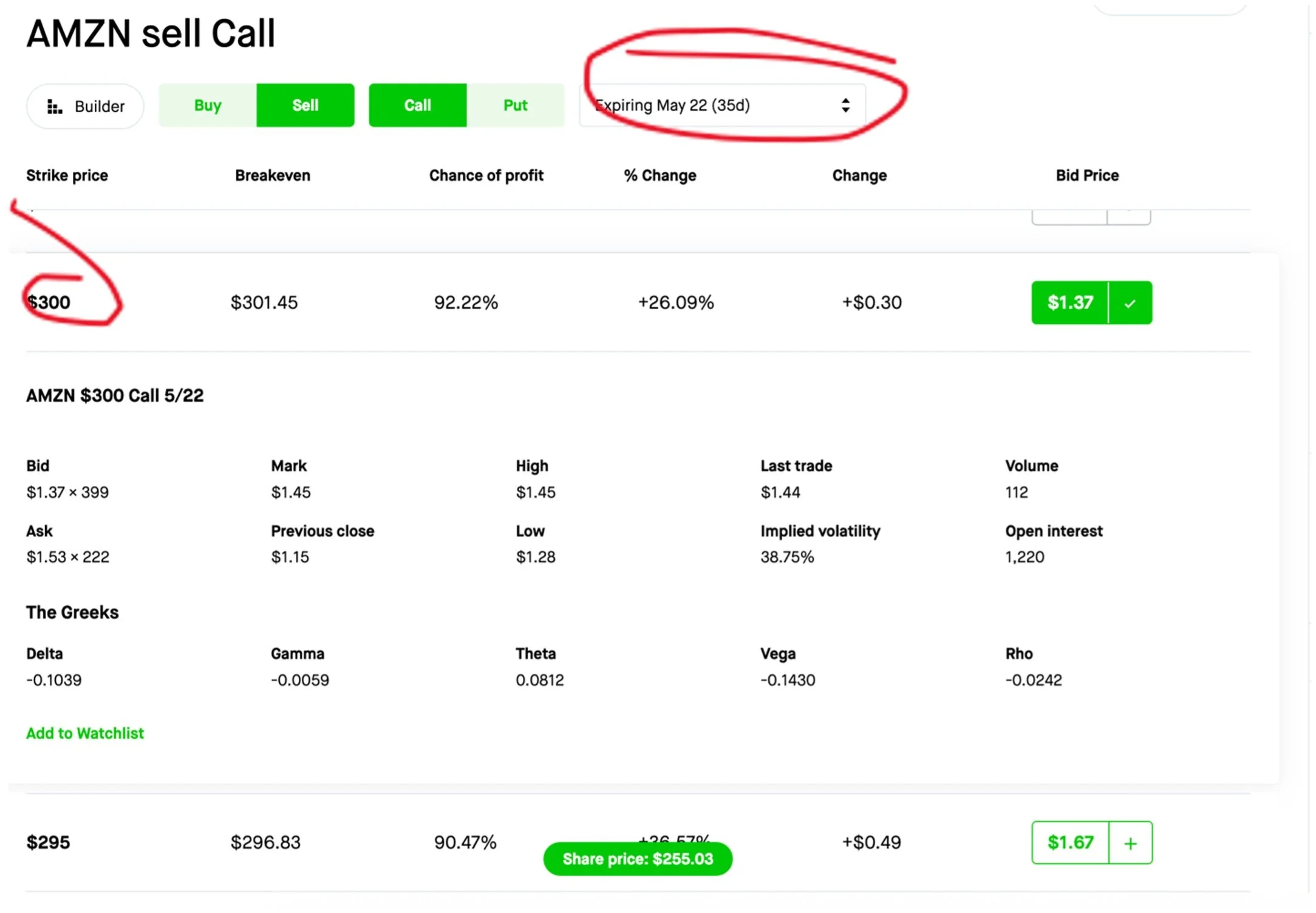
After pushing the buttons, you just sold your 1 contract that gives you the right, but not the obligation, to purchase 100 shares of AMZN on 12/15/28 for $150 per share.
You received $137 in cold, hard cash in your sale.
Fun!
Now, one of two things will happen.
AMZN will either be:
A. Trading above $300 on May 22
Or
B. Trading below $300 on May 22.
If AMZN is A, trading above $300 on May 22, the stock would have moved up 18%, and your option would be sold for about 30%.
The $13,315 you paid would have turned into about $17,406.

But you also got $137 on day 1, so your total gain would be about 32%.

Not bad for one month’s work.
If AMZN is B, trading below $300 on May 22, you keep your call expiring in 2028. You still have that $137 from selling the May call.
Now you can simply repeat Step 3 for another month out.
You are now a synthetic covered call fund master.

This strategy is also known as the “poor man’s covered call strategy” because, if you do it wrong, it’ll make you poor.

That isn’t why it has the nickname, but it’s true.
If the stock price goes down enough, you can’t sell monthly calls for income while you wait for it to come back up. You need to just sit and wait months or years and hope it rebounds.
If you pick a strike price BELOW the price of the stock when you bought your call in Step 2, you’ll sell for a loss.
If the stock price goes down and stays down, you basically lose everything.
To summarize, if the stocks go up, nice chunk of change. If the stocks go down, massive losses.
I mentioned you can just dollar-cost average into a market index fund, right?
So here is what our official five-ticker example Schmoozeletter synthetic covered call fund looks like:


And here is what it would make if everything was above their strike price in one month:

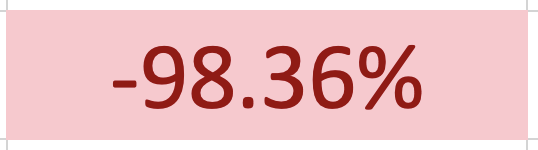
And here is what it would lose if everything fell off a cliff for three years:
Fun!
Final Thought
If none of that made any sense to you, you are probably better off.